


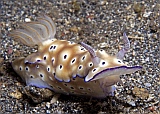
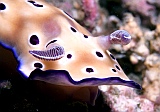
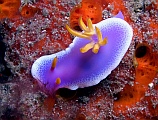

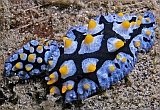


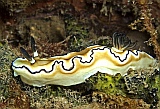


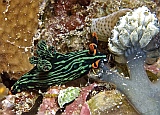


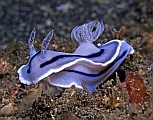


The name Nudibranch comes from a Latin/Greek compound word that means "naked
gill". They are members of the sea slug family and you can see the feathery, exposed
gills. These are some of the most brightly colored creatures in the sea, but the color is
there as a warning. Most nudibranchs feed on prey that's toxic to other animals and
store the poisons in their bodies as defense. The bright colors advertise their
unpalatability. Most of these are 1-2 inches in size, the two largest are the bright
yellow Notodoris and the giant (by nudibranch standards) Phyllodesmium which are
both five inches or more. The Phyllodesmium uses sunlight to grow algae (a micro
plant) in its body as an additional food source, they show as brownish spots. Hard
corals and giant clams also supplement their food sources with an internal algae
garden.
I have only shown the main family name for these. There are few "common" names
for the thousands of known nudibranchs and dense, impenetrable Latin nomenclature
is for the taxonomists, not me.
CLICK ON THUMBNAIL FOR FULL SIZE IMAGE THEN "PLAY" TO ACTIVATE
SLIDESHOW, OR CLICK "NEXT" FOR PICTURE BY PICTURE ACTIVATION.